

Latest Posts Subscribe to this blog RSS

Not much for the riot wombles at Lambeth volunteer speed dating

Last night I went to a “speed dating” event
organised by Lambeth Council.

Before you start to think this was some
strange kind of matchmaking service for public sector singletons, I should
explain. The “dates” were between locals like myself who wanted to volunteer
for projects in their community, and organisations in need of volunteers.
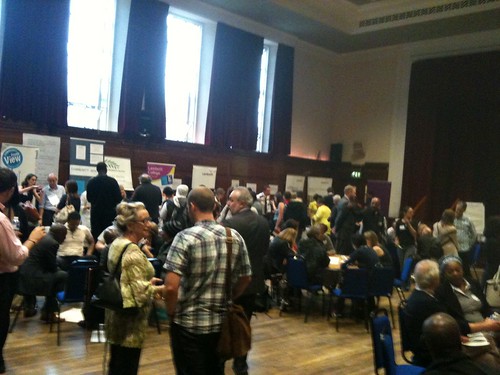
Lambeth Council's volunteering eveningIt was arranged as an attempt to harness
the community spirit shown by the so-called “riot wombles” who voluntarily
cleaned the streets after last week’s rioting. 

And the wombles were out in force. Hundreds
of would-be volunteers wandered around, fuelled by a generous buffet and some
hefty cupcakes, courtesy of Lambeth. They looked at projects ranging from oral
history to park maintenance and from hospital helpers to youth mentors.

But I’m not convinced the volunteering
organisations had understood the “wombles” phenomenon. Those who cleaned the
streets were, by and large, professionals with full-time jobs who were happy to
do a sporadic hour of evening work to give something back to their community.

But as I and my housemate wandered around,
we kept hitting the same hurdle: organisations wanted us in the daytime, during
the week, for several hours. We had to keep explaining that we worked
full-time, and asking apologetically whether one evening a week would be of any
use. The general consensus was a polite “no”.

Another thing that struck me was the number
of public sector bodies looking for volunteers at an event I had expected would
be made up entirely of charities and community groups.
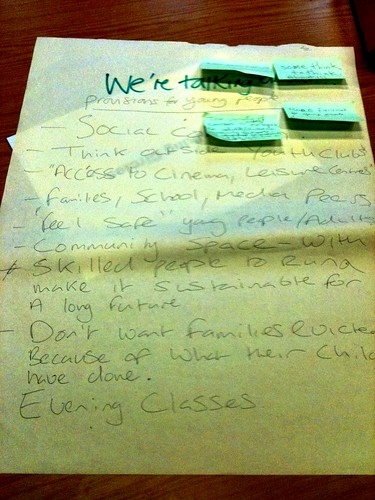
Post-it notes of ideas written down at Lambeth Council volunteering eveningGroups with stalls included Young &
Safe, a Lambeth Council programme tackling youth violence; King’s College
Hospital and the local police force, which was looking for volunteer special
constables. Lambeth Voluntary Action Council, a charity that brokers local
volunteering placements and a more obvious host of the event than the council,
didn’t even have a stand.

We left the event with armfuls of leaflets
and plenty of ideas, but no stand-out projects to volunteer for. We concluded
that, as with real dating, it can take time to find the right match.

How can the do-gooders who turned up after the riots be turned into long-term volunteers?

This week’s rioting in cities across
England has shocked the nation – but it has also prompted displays of human
nature’s better side.

I have experienced two such displays in the
past two days in my local area, Brixton in south London, where several shops
were looted and a Foot Locker store was set on fire during disturbances on
Sunday night. 

On Tuesday evening I joined around 30 or 40
other volunteers for ‘Riot Cleanup Brixton’, in which local residents
brandishing brooms, gloves and binbags took to the streets to clean up the
damage.

On Wednesday I went to a second event:
residents were meeting up to donate blankets, clothes, baby food and toiletries
to be sent to those in Tottenham made homeless by the riots.

At both events, there was a sense that we
do-gooders were of limited use: the streets were mostly clean by Tuesday
evening, leaving us to sweep glass from the doorway of a Vodafone shop and
remove a few shards from outside the station before retiring to a local pub.

On Wednesday, Haringey Council had
published a statement saying it was “overwhelmed with the generosity of
donations of clothing, food and many other items” and no longer needed more
blankets and clothing, before we made our donations.

Still, the events were gatherings of
well-intentioned locals who were willing to give up their evenings at short
notice to do their bit for others – even if it was more about making a
statement than offering much practical help. Similar events took place across
London, in Liverpool and in Birmingham.

The question now for the voluntary sector
is how to harness this sporadic goodwill that breaks out at times of crisis.
Can these last-minute do-gooders, who turn up in response to Twitter and Facebook
posts alone, be turned into longer-term volunteers who help out regularly at
charities that do the gritty, everyday work that is of real value to those
communities? And if so, how?

Read Kaye Wiggins’ blog for the Brixton Blog on the local clean-up efforts

Why do some causes raise more money than others?

Last week, Cass Business School published its new Charity
Market Monitor
, which looks at the most successful fundraising charities in the
UK.

One interesting factor was the differing success of
different charities. By far the most successful sector for fundraising was
health, with Cancer Research UK and the British Heart Foundation occupying the
two top spots, and health charities accounting for more than a quarter of all
fundraising.

It’s not surprising that health charities do well, because
people tend to fundraise for charities which have a strong personal and
emotional connection for them, or which tug heavily on the heart strings, and
health charities hit both targets. But even within the health sector, there are
massive differences. For example the Stroke Association raised £16.7m in
voluntary income, while the main breast cancer charities raised £21.6m, even
though three times as many people suffer strokes each year as are diagnosed
with breast cancer.

Recently, I’ve done a lot of fundraising myself for a health
charity, and I began to wonder why some health causes are more successful than
others at raising money from the public.

First, I would think it needs to be potentially fatal,
because this really concentrates the minds of fundraisers and donors. If a
disease makes you sick, but never kills you, it attracts less sympathy. Rightly
or wrongly, people are strongly motivated to fundraise and to give by the sense
of loss that comes with death, particularly if that death is a painful one.

Second, it should be something which isn’t always fatal,
because survivors make the very best fundraisers. The marathon is full of
cancer survivors who have been given the all clear and understand how lucky
they are, raising cash in thankfulness that they have the strength to run. For
diseases where no one ever recovers, this lack of survivors blights the
fundraising attempts.

Third, the disease should affect the right demographic. In
particular, people fundraise more for diseases which affect the young. Not only
do we all feel strongly for young people cut down by sickness, but because if
you survive a disease when you’re young, you fundraise for that cause
throughout your life.

The next best group is surely middle-aged women. Women
because they tend to raise more, give more, and have more friends to rope in,
and middle-aged because this is the age at which you tend to have the most
disposable income, and the strongest social networks.

Lastly, I suspect it’s good news for the charity if the
disease affects a part of the body that people like. I bet charities
supporting, say, pancreatic cancer sufferers, find it more difficult to raise funds
than those supporting people affected by  diseases of parts of the body that people are, shall we say, more fond of. And most of us
probably don’t really know what a pancreas is.

The Standard Chartered Great City Race featured the best-dressed audience I’ve seen on a sporting occasion

Last week, three months almost to the day
after the London Marathon, I took to the streets of central London once again,
surrounded by thousands of people running for charity. Roads were closed, and
people gathered around to cheer on the runners.

The distance was a little less dramatic,
mind. Instead of the 42 kilometre marathon, this was only a 5k. The name was
nice and long, though: the Standard Chartered Great City Race.

Standard Chartered Great City Race

And, mysteriously for me, instead of
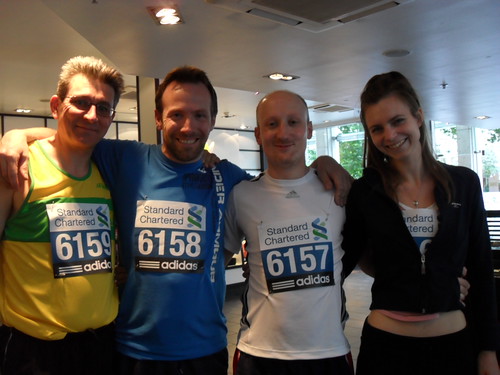
running by myself, I was part of a team of intrepid Third Sector adventurers
pounding the streets along
with 6,500 other runners for the benefit of the charity Seeing is Believing, which aims to tackle avoidable blindness,

There was a lot to like about it, too. The
staging ground, on the Honourable Artillery Company Ground near Moorgate, was a
beautiful location, with some pretty heavy duty architecture going on all
around. And the route was pretty spectacular, weaving through the towering
marble office buildings between Moorgate and Bank. The spectators, consisting
mostly of lawyers and financiers who worked in the surrounding area, were
comfortably the best-dressed audience I’ve seen in the flesh at a sporting
occasion.

There’s something disconcerting about
taking part in a sporting event while being watched almost entirely by posh
blokes in suits drinking G&Ts, but I suppose now at least I know how polo
players feel.

Indeed, most of the entrants were from the
same firms of lawyers and financiers, so there was a pretty similar demographic
on the route, as well. I was left with the nagging feeling that I might
conceivably be the worst-paid runner taking part.

Fortunately, though, I wasn’t the slowest,
finishing about a third of the way down the field, which I was pretty pleased
about, because attempting to run quickly is still something of a new skill for
me, after six months spent training for a marathon by running around Regent’s
Park, extremely slowly, being overtaken by overweight ladies and
septuagenarians.

This time, I even beat a couple of the
journalists from Runner’s World.

Indeed the Third Sector team as a whole
proved pretty sprightly, with two of my fellow runners well ahead of me in the
draw, and even our fundraising reporter coming in halfway up the field, despite
spending approximately three days before the race telling everyone that she was
extremely slow and would probably come last.

What the race did do was serve as a useful
bookend, because I’ve decided that it officially forms the first day of my
training for the next marathon.

Having raised so much money for charity in
2011, I am planning on running again in 2012, although this time in Brighton,
because I like the variety and the sea air, and because it’s easier to get a
place.

Anyway, with a bit of luck I’ll be back
soon to update you on my attempts to run and raise cash for charity, so expect
to hear more from me over the coming months.

Is the sector cheering an own goal over the abolition of cheques?

On Tuesday, the charity sector celebrated an announcement from the
Payments Council that it was  abandoning it target of abolishing cheques by 2018.

I think there’s a possibility that the sector may be
cheering an own goal.

This is partly because it’s cheering the end of something
that was never going to happen. The Payments Council never said that cheques
would be abolished. Cheques are a statutory instrument, and can’t be abolished
by the Payments Council. It would need primary legislation.

The Payments Council said the central clearing system would
be abolished.

This is the system which allows you to cash a cheque for
free. It’s an expensive system, and at present, the cost is borne by the banks.

However the banks have absolutely no obligation to continue
to pay for this system – none whatsoever. So come tomorrow, there’s actually
nothing to stop the banks refusing to accept cheques, or charging you every
time you write one. When it gets too expensive to manage cheques, that’s
exactly what they’ll do.

The Payments Council had promised that before it scrapped
the clearing system, it would introduce an acceptable alternative for everyone
in the UK.

Having spoken to them about one of these alternatives
it didn’t sound that bad. In fact it sounded like it might even be an
improvement.

The decision to scrap cheques, though, is back in the hands
of the banks, not the Payments Council. There’s no longer a promise that there
will be an alternative system in place. And we have no idea when it will
happen.

Of course, it may just be that cheques will just fade away,
and there will be no need to manage their withdrawal. Maybe they’ll go the way
of the telegram and the steam locomotive, quietly and without the need for any
replacement at all.

But it may be, equally, that banks will scrap cheques long
before there are alternatives. Given the track record of Britain’s banks in
looking after the vulnerable, the elderly, and the needy, I don’t think it’s
terribly likely they will consider their needs in depth when they take this
decision. It will be all about the bottom line.

I could easily see it happening before 2018, and it could
well be the case, when it happens, that charities and their donors have no
alternative at all.

I’m not sure the Payments Council was right – far from it –
and I don’t think it explained itself very well to anyone throughout this
debate.

But I’m not sure at all that the situation we’re in today is
an improvement on the one we had last week.

There are no hard and fast rules about charity campaigning

Acevo chief executive Sir Stephen Bubb appeared before a
committee of MPs recently to issue a stirring defence of the idea that
charities must be allowed to campaign for what they believed in.

However he was stumped when asked by Tory MP Robert Halfon
what the difference was between campaigning by Shelter and by the Taxpayers’
Alliance
.

I’ve had a bit more time to think about it than Sir Stephen,
and I reckon the difference is that Shelter campaigns on behalf of a distinct
and identifiable group of beneficiaries, whereas the Taxpayers’ Alliance
represents a point of view. Also, Shelter doesn’t exist just to campaign, but
provides services to those beneficiaries.

But the fact that someone as eminent as Stephen Bubb found
it difficult to pin down an answer shows how hard it is to lay down hard
and fast rules. To try to do so is to wade into a quagmire of vague
definitions.

I realised what a grey area is was recently when I found
that I had argued for both more liberal and tighter laws on charity
campaigning.

(There’s a term for this – cognitive polyphasia – which was
originally coined by an ad man who doubtless saw it as an opportunity to make a
quick buck. It defines, for example, our ability to believe simultaneously that
there is almighty God looking after us, and that he won’t mind if we never go
to church.)

After a bit of internal soul-searching, it was obvious what
the deciding factor was: whether the campaigning charities happened to agree
with me.

For example, three months ago we ran a series of stories
about how charities had effectively been kicked out of the debate on AV by
aggressive tactics on the part of “No” campaigners.

At the time, I read this, and I was outraged. Charities, I
thought, should be free to speak their minds. They should obviously be allowed
to campaign for a change in the law that made voting much fairer.

Shortly afterwards, however, I read a piece by another
charity, campaigning against GM food, which I happen to think is quite a good
idea in many parts of the world.

I realised that charities were campaigning for any number of
things I was opposed to: an end to nuclear power, looser laws on
homeopathy, more religion in schools.

And I found I was irritated because these people, through
Gift Aid, get tax relief, and that means my taxes are funding people who
promote these ideas.

MPs didn’t really seem to have any definitive argument for
or against charity campaigning, either. I got the impression they were mostly
annoyed that it took up a lot of space in their inbox, and wished the sector
would just shut up.

All of this leaves the Charity Commission in an invidious
position. The regulator got a fair amount of flak for refusing to issue a
definitive judgement on the AV debate, but it’s an impossible thing to do.
Campaigning needs to be judged on a case-by-case basis, and you can often only
rule after the event.

However charities know what’s good for their beneficiaries,
and should trust themselves. If they think that campaigning is what’s needed to
better the lot of their service users, they should have the courage of their
convictions, and get cracking.

Could merger problems be eased by matchmaking?

Our coverage of RNIB and Guide Dogs failing to find a common
path this week and last leads back to an age-old question: why aren’t there
more mergers in the charity sector?

In our analysis on the subject, Richard Gutch and Craig
Dearden-Phillips both said that basically, for mergers to go ahead, charities
need two boards with a common vision, and a chief executive who’s not too
fussed if they leave their job, and if you haven’t got this, forget it.

There’s more on the same in an excellent blog, two years old but hardly out of date, by Karl Wilding of
the NCVO. He picks out five problems that prevent mergers: cost, cultural
mismatch, fundraising worries, distraction from mission and “most damningly, a
lack of share options to cushion the blow to departing members of the senior
management team”.

In other words, he says, a merger offers a high risk to a
chief executive and his senior management team, but a low reward.

Wilding quotes an article in the New York Times saying the same thing: in the private sector, if you negotiate a merger, you
get a bunch of share options and a plush consultancy job. In the charity
sector, you get a bunch of flowers and a P45.

There’s a clear pattern here. People respond to incentives,
and the incentives are strong for charity chief executives to put the kibosh on
mergers at the earliest possible level.

Most charity chief executives are relatively selfless and
mission-driven, compared to the leaders of for-profit organisations, but
expecting someone to fall on their sword for the good of their
organisation is surely starry-eyed naivety of an outstanding level.

So that’s the problem. What’s the solution?

You can’t pay them to go. Charity supporters and
beneficiaries hate hearing about that, and in any case, that also presents the
wrong incentive. But one suggestion I’ve heard which may work is a matchmaking
service for staff involved in mergers. Make sure that there’s someone out there
whose job is to find any departing staff a better job, and you’re more likely
to get their support for a merger.

Why is the charity sector being outdone by private businesses?

This week, we’ve published an analysis of
welfare-to-work provision. This is historically an area where charities have
ended up as subcontractors to private providers. Many feel the sector gets
stiffed by this process.

Looking at the ages of those private providers, though, it seems the sector may have missed a trick somewhere along the way, because
most of these companies are younger than their charitable subcontractors.

Almost all were formed in the last 20 to 30 years, a period
during which many of the charities currently offering welfare-to-work services
have hardly changed at all.

How come charities haven’t achieved the scale that seems so
necessary, while these younger private businesses have become big beasts in the
welfare jungle? How has the sector been out-competed?

It isn’t on service. Charities are good at providing
welfare-to-work services, or they wouldn’t win all these subcontracts.

Nor are charities bad prime contractors. When the specialist
charity consortium 3SC was formed, it won substantial contracts under the
Future Jobs Fund, and immediately delivered on its goals better than just about
anybody. A similar consortium run by Social Enterprise London also had
considerable success.

I think, unfortunately, the flaw is in the charitable model.
Being a charity gives you a lot of advantages, but it makes you bad at getting
big.

Partly this is because charities don’t retain much cash for
growth, because they tend to spend it on needy people instead. A charity trying to grow will come under pressure from government, funders and its own
beneficiaries not to build up large reserves.

Of course many companies don’t get their growth capital from
operating profits, either, but from outside finance. However, the most frequent
way to do that is through equity – also not open to charities.

The charitable model also makes it hard to grow through
mergers and acquisitions. Most big companies are really aggregations of small
companies, brought together through the simple medium of hard cash. Charitable
mergers, their wheels not greased by the same lubricant of liquid wealth, take
longer and are less frequent than the corporate buyout.

The trouble is, you need scale to win prime contracts. And
charitable prime contractors are needed to get the best deal for charities,
which in turn means the best deal for beneficiaries. So it looks like the
sector will have to try to overcome the disadvantages of its legal model, and
build some seriously big charities.

There have recently been some concerted efforts to bring
this about.

One is the use of consortia and subsidiaries to deliver
contracts. A charitable special purpose vehicle, owned and financed by a number
of organisations, can attract enough income and have enough resources to
compete at scale.

The first attempt at a really large-scale project like this
is 3SC, the jobs consortium founded by the Social Investment Business. This has
met with mixed success, but certainly shown it can be done. Ian Charlesworth,
the man who created it, says he is well on his way to building as many as seven
more similar consortia.

The other factor required, for a sector which can’t attract
equity, is a new type of capital.

Here, too, there’s progress. The most talked-about example
is the social impact bond, which we hear about everywhere. It allows charities
getting paid by results to raise enough capital up front to provide services,
as well as transferring all the risk onto professional investors.

Let’s hope these solutions work, and that next time we see a
series of contracts as large as the Work Programme, the sector wins a fair few
more of them.

Fundraising and finance: the oddly successful couple

A while ago, I interviewed a finance director who claimed
she could tell which department of a charity she was in, just by looking in the
fridge.

Go into the finance department in her organisation, she
said, and the fridge was full of sensible sandwiches: ham and cheese on plain
brown bread. The fundraising department fridge, on the other hand, contained
only tofu, humus and sushi. The PR department fridge was always empty apart
from a bottle of sparkling wine.

I write about finance, and I mostly speak to finance experts
within the sector. When I meet them in person, at industry events, they obey
the stereotypes happily, almost joyfully.

The FDs know everyone thinks they’re boring, and they seem
to quite like it. They don’t chat for long at post-conference drinks, they
arrive ten minutes early for everything, and they wear grey suits and sensible
shoes.

For some reason they seem to suffer badly from hair loss,
too. Maybe it’s the realisation that there is a substantial saving to be had
from the hairdressing budget.*

Every so often, though, I go to fundraising conferences
instead, usually when they’re talking about Gift Aid and the like.

Yesterday I went to a payroll giving conference and
felt like I’d walked into a different world. Around 80 per cent of the people
were under 35. Of those 80 per cent were female, and of those around 80 per
cent were wearing some kind of floaty, flowery skirt, a strappy top, and
excruciatingly fashionable sandals. The blokes mostly looked fit and tanned.
Not a lost follicle in sight.**

I remember a colleague coming back from a two-day
fundraising conference exhausted. “They partied all night,” she said with a
sigh, as she sipped water at her desk. “They’re just so bloody jolly. I had to
lie outright to dodge them and get to bed.”

Go to a finance conference and in the evening, the bar looks
like a desert. At most, there will be three people in it, tapping away quietly
on laptops, not talking to one another.

It’s as if every charity contains two departments as
dissimilar and as united as Danny De Vito and Arnold Schwarzenegger in the
movie Twins. On one side hard facts and spreadsheets, on the other erratic
have-a-go charm.

Somehow, this odd couple partnership seems in most charities
to produce good results. But I’m baffled as to how.

* In the interests of full disclosure, I must admit I am a
card-carrying baldy myself, and cannot therefore really criticise.

** I know, you can’t see lost follicles. They’ve
disappeared. But you know what I mean.

Sir Ronald Cohen’s uphill struggle with the MPs

Last week, Sir Ronald Cohen, the creator of the Big Society
Bank and one of this country’s richest men, spent an hour and a half explaining
to a committee of Parliamentarians all the ramifications of the bank and of
social impact bonds (which he also had a hand in – his consultancy, Social
Finance
dreamt them up).

I wouldn’t blame him at all if he’d decided not to turn up.
Appearing before a Parliamentary committee hearings tend to fall into two main
categories, neither of them pleasant for those being heard.

The first is when MPs understand the subject and want to
tell the great and the good that they’ve done something very wrong.*

The second type, which Cohen faced, is potentially even
worse. It’s where the MPs involved don’t understand the subject at all (the Big
Society Bank, in this case) and fire irritated questions at their witnesses as if they were directly to blame.

Cohen found it an uphill struggle, to say the least.

Was social finance all about social impact bonds, the
committee asked. No, they weren’t, Sir Ronald explained patiently. Social
impact bonds were an important part of it, but only one element.

Wasn’t all of this just about payment by results, the
committee asked. Hadn’t the Work Programme reforms meant social impact bonds
were unnecessary?

Hardly, said Sir Ronald. Social impact bonds allowed small
charities with effective interventions to get into the game. Payment by results
left you with only a handful of big companies who could compete.

And so it went on, as Cohen and his associates patiently
laid out the principles of social enterprise, social finance, and the need for
a market to connect the two, and understanding gradually dawned among the
elected members.

Part way through, Bernard Jenkin, chair of the above
committee, achieved an apotheosis.

“The Big Society Bank has the reputation of being a bit of a
political gimmick,” he said. “But you’re explaining to us that it is the
conclusion of years of thinking about how to fund the social enterprise and
charitable sector. That’s incredibly important.”

It was, really, but it was evidently the point at which Sir
Ronald and co had expected to start the discussion, rather than the point it
reached after an hour.

It’s maybe unreasonable to expect MPs, with all the
innumerable demands on their time, to understand properly what’s quite an
esoteric subject. After all, there are certainly plenty of people within the
sector who haven’t really got their heads around social finance models.

But rather worryingly, these are the people who will shortly
write a report on the big society, including its finances, and it was concerning to see that they really don’t understand its technicalities very well.

One positive, however, is that at least the MPs on the
committee seemed to like what they heard. It was clear, when leaving the room,
that there was significantly more support for social finance than there had been entering
it. However it looks like there is still a way to go to really spread the good
word throughout the whole of the Palace of Westminster.

* Also last week, I watched Richard North, chair of the
Payments Council, face a Treasury committee with its dander ruffled over the
question of cheques. The MP chairing the committee sat down, smiled kindly at
North, and then tore into him like a starving leopard faced with a baby goat.

“Did you commit a colossal error of judgement?” was his
opening question. He then continued to ask the same question again and again
for about a quarter of an hour, despite the fact it was quite impossible to
answer either yes or no, until North plainly wanted to hide under the desk.