

Latest Posts Subscribe to this blog RSS

Blanket emails to MPs are lazy, wasteful and lack strategy

There is absolutely no point in sending someone a blanket
email if you are hoping to spur them into any kind of action.

This is the case whether you are hoping to convince them to
care about your cause, persuade them give a donation to your organisation or
even entice them into reading past sentence two of your email.

This is why it perplexes me that so many charities are
continuing to send MPs, a group of people who must receive rather a lot of
personalised correspondence, so many impersonal blanket emails.

At a recent Public Administration Select Committee hearing I
attended a number of MPs whinged about receiving too many of these emails.

And then Conservative MP Robert Halfon recently wrote about
the frightening level of such things in a blog post on the Guardian.
He said: “These computer generated emails are more a curse than a blessing –
and I believe do great damage”.

I’m not willing to in any way criticise charities that
campaign or lobby. Some of the most important work done on behalf of their
beneficiaries is through such activity.

But the way that some charities go about this is often lazy,
wasteful and lacks any kind of planning or strategy.

Yes, we all know it would cost more to send out personalised
emails and letters. But I firmly believe that even a little extra investment
into targeting and personalising this correspondence could yield the kind of
returns that would make it more than worthwhile.

It’s a sad fact of human nature, but as our inboxes steadily
become increasingly inundated, the only reason any of us ever take notice of a
blanket email is if we are going to benefit from it in some way.

On my work email the only reason I will make the effort to
read through such a thing is if it is giving me details of a particularly
interesting potential news story.

On my personal email this normally only ever happens if a
sample sale is being brought to my attention.

The truth is that organisations that continue to clog up my
inbox with blanket emails that have no relevance to me have become the kind of
company I would actively avoid in the future.

And with all these blanket emails it would seem that many
charities are risking having this effect on a group of people whose support
could be very useful to them.

Not only is it unlikely that such emails will ever get MPs
to support your cause, but you risk annoying them so much that when you do
eventually get your ask right, yours is possibly the last organisation they
will feel willing to support.
I’d love it if Sue Ryder won the VAT battle but I don’t hold out much hope

Recently, the government has been veritably
pelted with questions, largely from its own back benches, asking it about the
VAT burden it is placing on charities. In both the Lords and the Commons, on
both sides of the aisle, our political representatives clearly don’t think much
of charities’ current tax bill.

It’s also pretty clear that the government
hasn’t any great plans to change the situation, because every question has been
met with some impressive stonewalling.

The most recent question was last Thursday
from Stuart Andrew, Conservative member for Pudsey, who asked what estimate the
chancellor had made of the cost of the recent VAT increase on charities.

The chancellor sent out David Gauke, the
exchequer secretary, to answer, and Gauke flat-batted it.

He was clearly unwilling to provide the
whole truth, which is that the government has made hardly any effort to
identify the cost to charities, but it knows the answer, because it has been
told, and it’s at least £140m, maybe closer to £200m.

Instead he repeated, in effect, that
charities got a really good deal from the government on VAT, and that while
charities might incur VAT, “information is not available to assess accurately
the amount or the effect of the increase”.

It was more of the same on Wednesday when
Kris Hopkins, another Tory backbencher, asked David Cameron about VAT in Prime
Minister’s Questions. Cameron said that he was very concerned about the issue,
but he would have to consider the impact on other sectors.

It was little different on Monday from Lord
Morris of Manchester and Lord Alton of Liverpool, except that it was Lord
Sassoon, the commercial secretary to the Treasury, doing the stony-faced
denials.

“There are no plans to introduce any
additional VAT recovery schemes for charities,” he said. Otherwise his answer
was so similar to Gauke’s earlier in the week that the Treasury may have cut a
stencil for it.

In total, 11 MPs and peers asked questions
in as many days, and it’s no coincidence that a large number of them reference
Sue Ryder Care, which loses £1m a year to VAT.

The charity’s chief executive, Paul
Woodward, implied earlier this year that his charity is totally frustrated at
the toll extracted from its hospices. He’s responded by launching almost the
direct opposite of a charm offensive at the government.

It’s hard to blame him, really, because
it’s such a patent injustice. While it’s pretty scandalous that the government
doesn’t fund these services, it’s almost beyond belief that it then taxes
charities for doing so. If I was faced with that monumental level of
ingratitude, I’d probably be angry too.

Although I would dearly love it if Sue
Ryder succeeded, I don’t hold out much hope. It’s clear from the recent replies
that this government, like the last one, knows the right thing to do, but just
won’t do it.

They’ve all got it in for Dame Suzi

Axe hovers over quango queen,’ squeals the Daily Mail, in response to a Sunday Times piece headlined ‘Quango queen faces sack for attack on private schools.’ It’s unusual for the Telegraph not to be in there too. It’s not the first time the right wing press have had a go at Dame Suzi Leather, chair of the Charity Commission, and it won’t be the last. They’ve all got it in for her.

Whether there is any real substance in the latest stories, which suggest her contract might be terminated before its end date of 2012, is harder to judge. Is the ‘government source’ quoted by the Sunday Times actually a minister, or a backbencher pursuing a vendetta? The problem with these off the record conversations is that they are off the record: you never quite know the strength of the information.

So what’s the evidence? It’s clearly nonsense for these stories to say that Dame Suzi keeps making politically motivated attacks on public schools. She and her staff have done no more than carry out what the 2006 Charities Act required them to do, which is to set out and operate guidance on how charities should demonstrate that they provide public benefit. Their formula requires fee-charging schools to do a bit more than some were doing in the past, without laying impossible burdens on them. Dame Suzi’s statements on the subject have consistently been mild and conciliatory rather than confrontational.

But there is, inevitably, a political dimension. The commission’s formula, by a happy coincidence, helped the former government to square a tricky political circle – to appease the ‘Eton can’t be a charity’ faction in its own party while doing nothing that would seriously damage the independent schools. The formula lays more emphasis on the provision of bursaries than other elements in public benefit, and the wrangle about whether that conforms with case law is going before the charity tribunal in May. This should have happened sooner, but it’s the right and normal way forward.

On another front, it is true that Dame Suzi has not flinched from saying what many others in the charity and voluntary sector have been saying – that the swingeing cuts coming down the line could put the whole big society agenda in peril by damaging the community infrastructure on which it often depends. Many in the sector will be grateful that she has been willing to defend them and tell the truth as she sees it instead of toeing the government line or staying silent.

Dame Suzi might be particularly vulnerable because she chose not to resign her Labour party membership when she took over the job, and because she is perceived as coming to prominence by Labour patronage. There are a lot of Conservative backbenchers and backwoodsmen who are aching to bring her down. Some of their attacks are nasty, vindictive and personal.

As for the government, it knew what she was all about when it came to power and could have arranged a decorous exit for her at that point. It chose not to. Ministers might well be irritated by some of Dame Suzi’s remarks about the big society, but it still seems likely they will allow her time at the commission to run its course. There are, if you look around, more important things for them to deal with.   

Is advertising for charities really necessary?

Last week a number of MPs and Thomas
Hughes-Hallet, chief executive of Marie Curie Cancer Care, criticised some
charities for spending too much on advertising.

The comments created quite a backlash on
the Third Sector site and a question has been hanging in the air over whether
some charities do indeed pump too much of their funds into this rather than
their frontline services.

I believe I have personally been motivated
to support a charity because of an advertising campaign.

The decision was coupled with the fact that
I was already looking for a charity that works with animals and the environment
to support because I felt guilty about no longer being a vegetarian.

But nevertheless I do think that, even if
subconsciously, this particular charity’s advertising was a major factor that
swung my monthly donation towards it rather than another with similar
objectives.

A balance must be struck, though.

We are all bombarded with so many messages
and sales pitches every day, and the last thing any charity needs is for their
message to be put into the same box as all the other annoying noise in the
heads of would-be supporters.

Then there is of course the argument that
some supporters will become enraged that too much money is being ‘wasted’ by
charities on self-promotion. Whether or not you agree with this argument, if it
is a viewpoint some people have, then that is worth bearing in mind when it
comes to protecting your brand.

But no one is going to give to a charity
they do not know exists. Just as no one is going to buy a product they do not
realise exists.

There are, obviously, other ways that
people can come across charities, maybe through personal experience or
word-of-mouth.

But for many charities, to be noticed by a
mass-audience a mass-awareness drive must be launched. And advertising was created to achieve
exactly this.

Inspirational, carefully placed advertising
does still play an important role for charities. It is usually this that will
raise awareness of their work, which will in turn raise funds, and it is only
with those funds that their frontline services will exist at all.

The big society backlash

It’s surely not a coincidence that the Times, a Murdoch paper, has run a negative lead story on the big society a few days after Andy Coulson, former editor of another Murdoch paper, resigned from his job as the government’s communications director.

After all, political commentators have noted that Coulson was never big on big society and did not always see eye to eye with Steve Hilton, the Prime Minister’s director of strategy, who has been seen as one of the agenda’s chief enthusiasts.

But whatever the source of briefings to the Times, the story is not without substance. Some Conservative MPs have been sceptics about big society since before the election, Labour have always attacked it as a cover for cuts, and it’s getting harder for the government to convince the world that the big society means anything.

One of the biggest problems, as I mentioned in an editorial before Christmas, is that the timing just isn’t right. The cuts in national and local government spending are hitting everyone before big society programmes, such as they are, kick in.

This point was reinforced last week by Justin Davis Smith, chief executive of Volunteering England, who pointed out that a lot of volunteer centres are likely to be closing down because of council cuts before the government’s promised £42.5m volunteering infrastructure fund comes into play.

So perhaps crunch time is looming for the big society. Nick Hurd, the Minister for Civil Society, is reported by the Times to have written a 12 page big society call to arms for MPs and Conservative activists, and is expected to meet voluntary sector leaders later this week to respond to their concerns about the cuts.

The big society has had a long honeymoon period because it’s a beguiling notion that many people instinctively respond to. But that period now seems to be over, and something more definite and concrete will be needed if the whole thing is not be swept away in the torrent of bad news on spending cuts.

Apple needs to get moving on a donation app before the brand gets tarnished

I’ve decided it’s time to add my two cents worth on the ongoing battle to convince Apple to allow people to donate to charity directly through apps on the iPhone.

The saga has been rumbling on for a while now and if it’s ever going to have a happy ending it’s going to be critical to keep the pressure on and not allow the story simply to simply fade away.

For those unfamiliar with the tale so far, for the past few months pressure has been mounting on the technology company to allow people to donate to charity directly through an iPhone app rather than having to go through a website.

Having an app could make giving quicker and easier – key ingredients for successful fundraising.

Almost very step of the way, Apple has refused to provide comment on why it is refusing to allow this.

Many have speculated that this is because Apple takes 30 per cent cut of all money spent directly through apps, and this would also have to be the case for donations made through apps.

Some argue that this wouldn’t matter – that 70 per cent of a donation is better than no donation at all.

But the reality is that if a global giant like Apple started taking almost a third of donations made to charity, there would be uproar that might tarnish the brand for a long time.

There isn’t an expectation for it to be free. Most trusted methods of giving, such as websites like Just Giving, take a cut of each donation to cover their costs.

It’s just that it is normally around the 5 per cent mark rather than a frightening 30.

My hope, although I’m pretty sure it is in vain, is that somewhere behind the scenes a policy team at Apple HQ is working out a feasible way of doing this.

It won’t be easy though. Setting something up which allows donations to be processed differently to other purchases could open up a can of worms for the company.

So, although I think this is something Apple needs to get moving on, it may not be as straightforward to put into place as it may seem.

There’s a massive slice of brand value at stake here, and a company like Apple is not going to risk throwing away its shiny image for the sake of pacifying a few thousand people who are frustrated about the absence of an app.

Chuggers should steer clear of the other salespeople

Grabbing a quick break in a busy day yesterday, I nipped to the less-than-glamorous destination that is Hammersmith Broadway, a small shopping arcade built around the entrance to the tube station.
 
During my roughly 100-metre walk through the centre, I was stopped three times.
 
The first was by a heavily made-up woman trying to sell me a bag of “luxury beauty products”. I said I wasn’t interested, and carried on walking, feeling a bit harrassed.
 
The second was by a burly bloke asking me to join the local gym. I told him (truthfully) that I was already a member, and carried on.
 
By this point I was starting to get annoyed that I couldn’t just be left alone to pick up a coffee (and, I admit, concerned that I must’ve looked like I needed both of the products…)
 
And then I was stopped again. This time it was by a friendly World Vision chugger, asking me to sign up. My response, I admit, was more curt than usual. I certainly didn’t stop to talk to him.
 
There’s something really wrong with sending chuggers to a busy place like this.
 
By lumping themselves in with those flogging cheap make-up and gym memberships, charities become just another annoyance to busy shoppers who might otherwise be supportive of their work. Worse, they look like they’re only interested in getting at your wallet, like all the other salespeople in the arcade.

Hiding your commercial credentials under a bushel

Many in the sector have a sceptical eye, and it wasn’t long before Frank Buckley applied his to the new online shopping app Give As You Live.

He is the chief executive of Down Syndrome Education International, and he noticed that it wasn’t easy to find out how Everyclick, which runs the app, is making the money to finance it.

You find out very quickly from the Everyclick website and from all the publicity material about the Give As You Live launch that if an online shopper uses the scheme, participating retailers will give about 2.5 per cent of the value of the purchase to the shopper’s nominated charity. Fantastic, you think: brilliant.

But to find out how Everyclick brings in the money to finance the necessary IT systems, or even to establish that it is a for-profit company in the first place, you have to dig a lot deeper. It’s not in the FAQs about Give as You Live on the website. Only when you start ploughing through the small print under the ‘legal’ button do you discover, about half way down, that the retailer gives Everyclick a commission about the same size as the charitable donation.

Nothing too dastardly about that, most might think. It’s not as if prospective shoppers are being deceived, and once they knew they would probably shrug their shoulders: it would be nicer if the charity got the full five per cent, but the system’s got to be paid for somehow, the commission seems reasonable, and the 2.5 per cent charitable contribution is not at all bad.

So why isn’t Everyclick more upfront about the fact that it’s a for-profit company and is working on commission? One argument might be that it’s not necessary to burden everyone with this slightly technical background information that’s not of direct relevance to the ordinary consumer and the charitable scheme.

Another view might be that hiding the commercial details under a bushel is a calculated ploy to leave people with the impression that Everyclick is itself somehow charitable, and thus to keep onside those who might jib at the red-blooded commercial component of this scheme.

My view would be that Everyclick and various other commercial outfits that do great work for charity should be a bit clearer and more transparent about their commercial credentials. At the very least, it would save them from having sceptics like Frank snapping at their heels.  

Hazel Blears risks stepping on Roberta Blackman-Woods’ toes

Hazel Blears is back, and she’s set her
sights on the voluntary sector.

The fiery readhead (now with a toned-down
auburn hairdo) has been keeping a close eye on the government’s big society
agenda, which she says it has stolen from Labour. And now she’s trying to
improve it.

Blears has tabled a private members’ bill
that she thinks will pressure banks to give more money and staff time to
community groups. She has also written to charities minister Nick Hurd, asking
him to guarantee that assets transferred from the public sector to mutuals and
co-operative groups can’t later be sold to the private sector.

Both moves are well-intentioned, but they
risk stepping on the toes of Roberta Blackman-Woods, Labour’s shadow civil
society minister, who has so far been relatively quiet.

And the ideas are baby steps compared to
the work Labour will have to do to claim back the big society agenda, which
Blears claims is founded on her own party’s principles of co-operation and
mutual action. 

After 13 years of Labour government, the
coalition found it easy to claim voluntary and community action as its own home
ground. Blears and the rest of her party face a difficult fight to claw it back. 

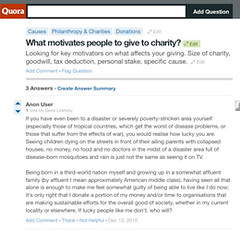
Is Quora the next Twitter? And should charities have it in their sights?

Twitter has been alight this past week with
talk of the online craze Quora.

While the website isn’t new (it was
actually founded in 2009), momentum has been growing over the last few months,
with opinion seemingly split on the network’s merits.

QuoraFor those who aren’t already familiar with
it, Quora claims to be ‘a
continually improving collection of questions and answers created, edited, and
organised by everyone who uses it.’

So it provides in-depth
commentary to questions and allows others to add to the answers and provide
further context.

For journalists, students
and tech lovers the website will probably prove a helpful resource, but will it
have the same appeal as Twitter and Facebook for charities?

To answer this question Third Sector
took to Twitter to gauge how our followers were reacting to this new craze. The response
wasn’t great.

Whether it’s yet on their
radar or not remains to be seen, but the reaction we did get was somewhat
mixed.

Digital expert Fernando
Rizo pointed out that, at the moment, branded accounts are not allowed on the site – which means that charities are not allowed to set up accounts to ask or answer questions. But he didn’t rule out charities getting involved as charities can have a person using his or her own identity on
the site.

Another comms expert suggested
the social media tool could be used for filling knowledge and expertise gaps,
and for widening networks.

One charity professional
professed to be ‘looking into it’.

The jury seems to be out on
whether Quora will be as big as Twitter, but it’s worth getting it in your sights.