

Latest Posts Subscribe to this blog RSS

Can people be nudged into giving more?

Tucked away on page 19 of the government’s green paper on giving are two short sentences that speak volumes.

“We know that tax reliefs for charitable giving provide incentives for donors and support to charities more generally”, it says. “We will review the relationship between financial incentives and giving.”

End of discussion.

Yes, we do indeed know that tax reliefs are a big incentive and are one of the key reasons why giving levels are higher in the USA. So if the government is serious about raising giving levels in the UK, why is the subject not discussed more fully in this consultation document?

The answer is likely to be that the Treasury put the kybosh on that at an early stage. In the current squeeze, anything that might reduce the tax take is probably seen as a complete non-starter.
So tax incentives go firmly into the ‘jam tomorrow’ folder, where they are likely to stay for some time, and the green paper concentrates instead on other proposals.

Flick forward to page 30 for an insight into these. This is the references page, where two entries catch the eye.

One is an article in the Journal of Personality and Social Psychology from 1990 entitled ‘A focus theory of normative conduct: Recycling the concept of norms to reduce littering in public places.’

Another is from Science in 2008 entitled ‘Spending money on others promotes happiness’.
There’s plenty of discussion about that sort of thing in this green paper, which says “insights from behavioural science have enormous potential.” It talks, for example, about creating “a peer effect that leads to giving spreading and growing.”

It’s no secret that there’s great interest in this kind of thing in the Cabinet Office, where the Strategy Unit, which works closely with the Office for Civil Society includes a behavioural insights team.This is the outfit that has been promoting the notion of ‘nudge’ – the idea that people’s behaviour is hugely influenced by social norms and what they see their neighbours and peers doing.

So can people be nudged into giving more? Or is the more powerful driver of human behaviour always an economic one? Discuss…

Arise Sir Stephen – and honour is satisfied

For a long time it was a moot point whether Stuart Etherington, chief executive of the National Council for Voluntary Organisations, or Stephen Bubb, head of the Association of Chief Executives of Voluntary Organisations, would make it first on to the honours list.

Etherington had length of service, gravitas, a longer track record and a diplomatic ability to impress his views on people without falling out with them. He was cautiously even-handed in his treatment of politicians.

Bubb was flamboyant, prepared to be controversial, and willing to make a noise in pursuit of his main theme of increasing public services by the sector. He was an admirer of Tony Blair and New Labour, but also at ease with the Tory-led coalition. And his first act on being knighted was to give an interview to the Times calling for a tax on bankers’ bonuses. 

Those who backed Etherington were vindicated last June when he was made Sir Stuart in the Queen’s Birthday Honours List. Now, only six months later, Bubb has been knighted in the New Year Honours List. So two men who are often portrayed as rivals are now on a level footing in that sense at least.

Etherington’s main achievement has been the NCVO’s twelve-year-long fostering and taking foward of the Deakin report, which led to the Compact and the new framework for charities in the 2006 Act. Bubb’s has been to cajole and chivvy politicians during his ten years at Acevo into accepting the case, and improving opportunities, for the sector to deliver public services.

But both men would probably be the first to accept that the most significant accolades in the honours list go to the many scores of people all over the country who contribute day by day to the well-being of their communities through their charitable and other voluntary work.

One example, picked almost at random from the 998 people on the list, is Jane Howitt, who since 1988 has given on average 20 hours a week to East Devon Audio-Description Service for blind and partially-sighted people. People like her make for the good society that exists – has always existed – in most parts of the country.

The government is spinning the list as a recognition of contributors to its big society agenda. That’s fine too – but the challenge that faces ministers in the coming year of cuts is to order matters in such a way as not to throw the big society baby out with the deficit bathwater.

Talking tough on Hard Talk

It’s the trademark of the BBC news channel’s Hard Talk to give its interviewees a good pummelling. And the gravel-voiced Stephen Sackur didn’t hold back when questioning Sir Stuart Etherington, of the National Council for Voluntary Organisations, about the big society at the weekend.

Wasn’t Sir Stuart a bit complacent about the cuts that are hitting the sector? Where was the anger, the sense of outrage? Wasn’t the sector just being asked to put a Band-Aid on the wounds the government is inflicting on society?

Etherington, in a disconcerting outfit of chalk-striped suit with no tie, stuck to a measured formula, declining to be provoked or become over-excited. And this calmness belied the strength of some of his statements.

He pointed out that the government had not grasped that voluntary action was not “a free good” and needed resources. The big society was a high-risk agenda, he said, and there was a conflict between the government’s central grip on spending and its promotion of localism.

Some communities were better placed than others for local action, he went on, and if the government was concerned with equity it had to build capacity in poorer areas: “A network of support agencies needs to be retained.”

That’s fairly forthright stuff, and ministers would do well to take note of it. But there were a couple of sideswipes at the public and voluntary sectors too.

There was a passing reference, for example, to some public services being run for the benefit of the people providing them, and he acquiesenced to the proposition that some charities were too dependent on state funding.
Like who, he was asked?

Action for Children and Citizens Advice were the two examples he gave. There’ll be a few hackles rising over the former – not least because ACH chief executive Clare Tickell is an NCVO trustee.

The commissioning reform green paper contains something that could alarm the sector

While flicking through the Office for Civil
Society’s green paper
on commissioning reform,
I came across something that might alarm the sector.

The document is looks at ways to make it easier for
civil society organisations to bid for public service delivery contracts.
Sounds uncontroversial enough.

It even provides an innocuous-sounding
definition of civil society: “Mutuals, cooperatives, charities and social
enterprises.”

But the next paragraph says this: “The
government recognises that that many mutuals and co-operatives are
profit-making businesses, which operate for primarily commercial objectives.
However, they are included in this definition owing to their role in public
service provision.”

It sounds, then, as if all of the special
consideration being given to the role of the voluntary sector in delivering
public services – including the ‘right to challenge’ due to be in the Localism
Bill – will be given to profit-making businesses too, as long as they can show
that their staff have some say in their governance.

Is it alarmist to suggest that this might
cause not-for-profit service delivery groups, who are more likely to struggle
anyway under the payment-by-results model that the government is keen on, to be
squeezed out of the market?

Or that it might encourage new, large-scale
businesses to set up on a ‘mutual’ basis, with the aim of winning as many
service delivery contracts as possible?

Perhaps it is alarmist, but it’s possible.

Big society conference has a whiff of civil disobedience about it

On Tuesday I listened to people from the often-unheard community sector
discuss the big society.

There was no government speaker and hardly any suits or ties in the
room.

A rather hirsute man wearing jeans and a Jimi Hendrix t-shirt, and with
a strong West Midlands accent, chaired the event. Very nearly half the 35
delegates were women and 10 were non-white.

There was plenty of anger, a bit of swearing and a whiff of civil
disobedience.

It’s probably fair to say most people there aren’t fans of the big
society and won’t be on civil society minister Nick Hurd’s Christmas card list.

Many voluntary sector conferences can be a bit sterile and formulaic.
This one, organised by the Community Sector Coalition, was passionate and anarchic.

It was probably the last conference I will attend in 2010 and it was
certainly the most fun. It was also, without doubt, the most representative of
the majority of people who work and volunteer in the third sector.

We survived the Homeless Hacks challenge…

On Friday night, my fellow reporter Sophie Hudson and I slept rough in Spitalfields Market.
 
Homeless Hacks ChallengeNo, it wasn’t because times are tough in the journalism business these days. It was a fundraising event held by the charity Action for Brazil’s Children.
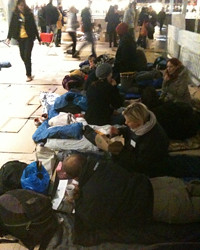
 
We managed to smash our fundraising target of £150 each: so far we have raised £456.65 between us, and there are promises of more now that we’ve done it.
 
The challenge was tough enough to warrant the sponsorship. Sleeping on a cardboard box on a concrete floor in the middle of November, even with plenty of layers, is not easy.
 
The next morning we felt groggy, dishevelled and very conspicuous as we walked towards Liverpool Street station with our sleeping bags and ruffled hair, smelling rather stale. We realised how quickly a homeless person could become a social outcast.
 
But we also realised how much potential there is for charities to raise funds by holding events that have a strong connection to their cause.
 
About 50 people were willing to sleep rough on Friday night, many of them socially aware, campaigning students looking for a new experience. It’s an exciting market for charities, and one that could probably be tapped into further with more unusual, attention-grabbing events.
 
Homeless Hacks Challenge 2But one thing did strike me about the event on Friday: there was little connection between the event and the charity’s cause area. Action for Brazil’s Children funds education projects in Brazil – a worthy cause but one with little connection to sleeping rough in London.
 
The experience has made me much more likely to give to charity, but I will probably choose a UK-based homelessness charity rather than Action for Brazil’s Children.
 
It begs the question: Should charities hold exciting fundraising events for their own sake, or should they hold off, in order to avoid saturating the market and to leave the space free for charities to whom the events are more relevant?
 
PS: Visit our Virgin Money Giving sponsorship page if you do still want to sponsor us.


Homeless Hacks fundraising challenge Day Four

We did it! Yesterday Kaye and I smashed through the £300 fundraising target and managed to raise £335 – and that’s without counting any of the Gift Aid.

I would not necessarily say this is down to any particular genius on our part. Echoing what I wrote yesterday, I think it has been largely down to the very generous nature of our friends and family.

So…with the challenge itself still a couple of days away, what now?

Do we sit back on our laurels now we’ve managed to reach our target? Or do we continue to push as hard for more sponsorship now as we would if we were still barely half way to reaching it?

As much as I’d love to be an idealist and say I will continue to push as hard as ever for more, the truth is, now we’ve broken the £300 barrier, I just do not believe we will be putting the same amount of extra time and effort into generating more funds that we would be had we not got there yet.

It begs the question whether setting targets like this is a good idea.

Action for Brazil’s Children did, of course, use the words ‘or more’ when setting the £150 per person, but having the figure there at all gives you a goal which is hard to ignore once you’ve managed to hit it.

At the same time, I don’t criticise the charity for setting one. Without it, many would probably be satisfied having raised half this amount, without realising that had they pushed a little harder it would have been possible to double their sponsorship.

It’s certainly something for charities to consider very carefully, though. Perhaps in some ways it may be better to set a slightly ludicrous target of, let’s say, £1,000.

Or is that even so ludicrous? If that had been the goal all along would we have just knuckled down and made sure that we hit it?

Homeless Hacks fundraising challenge Day Three

So, Kaye and I did well with our fundraising yesterday. We’ve managed to raise £265 in two days. In fact, with the Gift Aid, we have already broken through our £300 target.

We’re both lucky to be surrounded by a group of very generous friends and family, who have been incredible with their support. But personally I have still found it to be quite an unpleasant experience asking people for money.

This is not because I thought any of them would mind me asking, or begrudge giving the money to charity, but because it is just not a very natural thing to ask people for their hard earned cash without feeling a degree of guilt at the same time.

The only thing which has made it bearable is the fact that I have been able to explain that I am going to be putting myself through a slightly unpleasant experience for this cause.

Tell anyone who cares about you that you will be sleeping outside during November, and they are pretty willing to pay some sponsorship towards it. It’s almost as though they feel this is their way of giving you a warm blanket for the night.

I know that’s not the point. The point of the sponsorship should be all about the wonderful things the charity is doing, and I’m sure that helping a good cause is at least one part any sponsor’s motivation.

But look at any JustGiving or Virgin Money Giving page and most of the messages from sponsors will be words of good luck for the people raising the money rather than heart-felt thoughts about the good work the charity does.

That’s just the reality of the situation and charities need to tap into the fact that although the people who sign up to take part in events may feel some kind of connection to the cause, the people sponsoring them may not.

I think that both the events themselves and the ways that participants can ask for sponsorship need to be tailored to make the most of this reality.

Ditching a bad piece of law

In last week’s New Statesman, the magazine’s political editor, Mehdi Hasan, coined the ideal phrase for one of the least pleasant tendencies of the last government.

He wrote that the former immigration minister Phil Woolas, stripped of his parliamentary seat after an electoral court found that he told race-related lies about his Lib Dem opponent, embodied “the cynical, authoritarian populism of New Labour.”

Coincidentally, on the same day, Third Sector heard that the new government is going to repeal another example of that same tendency – the provision, railroaded through parliament last July in the face of widespread opposition and the unequivocal message from consultations, that the citizenship applications of migrants would be fast-tracked if they did voluntary work.

Ditching this measure is a sensible, principled decision. Giving people a specific material advantage from doing voluntary work is a perversion of the voluntary principle. It discriminates against those unable to volunteer and eats away at the foundations of altruism. Full marks to ministers on this one.

But why don’t they shout the decision from the rooftops? Are the spin doctors advising them to keep it quiet for fear of upsetting this or that constituency or faction? They should come out with it, loud and clear.