

Latest Posts Subscribe to this blog RSS

The 2011 Budget looks like a tale of two sectors

It’s good news to see the charity sector feature more
prominently in a budget speech, as well as a raft of new tax reliefs.

It looks like a tale of two sectors, however. Those which
rely on donations will profit from new tax reliefs estimated to be worth over
£500m a year. But those who get their income from government grants and
contracts – arguably the hardest hit group in the current climate – are not
sitting so pretty.

Osborne has been particularly generous to organisations
which rely on a small number of major donors. He’s promised an increase in the
level of benefits charities can offer major donors, together with a more
generous inheritance tax threshold for people giving 10 per cent of their
assets to charity. Perhaps the biggest winners here will be arts organisations,
who have been sorely in need of good news in recent months.

At the other end of the scale, the ability to claim Gift Aid
on £5,000
of small donations with reduced paperwork will help many smaller
organisations. It also makes shaking a tin on the high street a much more
attractive proposition, as these donations can now potentially attract Gift
Aid. A new system to claim Gift Aide online will benefit all sizes of charity,
but particularly the smallest.

There is, of course, still a lot of detail still to be
hammered out on all of these changes. Anti-fraud measures could yet be
introduced for the small donations rule which will make it less attractive.

HM Revenue & Customs has previously resisted extremely
strenuously any calls for a “de minimis” limit like the one proposed, so it has
clearly happened because of strong political pressure from above. Unless top
politicians remain vigilant, HMRC are unlikely to allow a limit like this to be
introduced without hedging it around with caveats and restrictions.

It’s service delivery charities I feel a bit sorry for,
however. Smarting from the loss of government grants and contracts, they’ve
received little relief. An extra £7m for the Transition Fund, announced earlier
this week, won’t go far. These charities will just have to wait hopefully for
Eric Pickles to announce sanctions on councils who’ve made “disproportionate”
cuts to the sector.
McLean’s departure is a blow for the IoF

Amanda McLean’s resignation after only four
months as chief executive of the Institute of Fundraising is a huge talking
point in the sector. It’s the second most read story of the year on Third
Sector
‘s website, with a dozen comments left by readers and letters still
coming in to the magazine.

Her departure can hardly fail to have a
destabilising effect on the institute. Organisations need strong leadership in
difficult times like these, and it will be several months before someone else
can be recruited.

McLean’s stated reason for resigning is
that she has small children and needs to spend more time with her family. The
children have not suddenly appeared since she took the job, and ideally both
sides in the recruitment process would have made a realistic assessment of this
question before making their decisions. If such assessments were made, they
have proved to be faulty.

McLean’s CV shows that she has stayed for
only two years in her last three jobs. One would have thought that the
institute would want to be confident that its next leader was likely to say for
a minimum of three years, and preferably longer. Again, if this question was
explored, a faulty judgement was made.

If a parting is amicable, as it is asserted
to be in this case, one might also expect the jobholder to work their notice in
order to smooth the process of recruiting a successor. But McLean is going
immediately.

The explanation offered is that it would
not be a good idea for her to stay because people would be expecting her to
outline her plans for the organisation, which would no longer be possible
because of her imminent departure.

These are always difficult and sensitive
matters, and it is easy and potentially misleading to speculate without the
full facts and to pass judgement with hindsight. We do not know the pressures
and problems of the  recruitment
process, for example – who the other applicants were, and what choices there
were. But speculation is inevitable.

For what it is worth, my own feeling after
several short meetings with McLean and one longer one was that she was not
settling comfortably into the role. It was therefore not a great surprise when
the news broke – although it was a bit of an embarrassment for Third Sector
because we had just published the first detailed interview with her.

Is celebrity involvement in charity campaigns always the right thing?

The #twitrelief campaign by Comic Relief
received a surprising amount of criticism on the social networking site Twitter
last week.

The campaign featured an online auction
that enabled members of the public to bid money for a celebrity to ‘follow’
their tweets, as well as for other extras.

These extras, some of which were much
more enticing than the ‘follow’, in my opinion, included a walk-on part in the
next Richard Curtis film, the opportunity to be a guest on the Christian O’Connell
Breakfast Show
on Absolute Radio, and the frankly less appealing chance to
watch comedian Ruby Wax have her next Botox injection.

Within just a few hours of the
campaign’s launch, the hashtag #twitrelief was one of the top trends on
Twitter, something which most charity campaigns can only dream of.

However, the majority of the comments
regarding the campaign weren’t positive.

Some Twitter users claimed it ‘went
against the spirit of Twitter‘ to pay for follows; while others considered it
condescending that celebrities thought their follows were worth so much money. Others asked why the rich celebrities didn’t just donate money from their
own pockets instead.

A number of the
celebrities involved hit back by asking ‘isn’t all
money raised for charity a good thing?’

The campaign does raise the interesting
question of celebrity involvement. Members of the public often react negatively
to being asked to donate money to charity by people considered to have much
fatter wallets.

But who is to say how much these people
donate privately? Wouldn’t we be sceptical of a famous face who bragged about
how much they were giving away and what their true motivations were?

While debate continues on whether
#twitrelief was a good idea, I’m going to stick my neck out and say I believe
it was. Looking at the amount of money that has already been bid and thinking
about the people it will help, it simply can’t be a bad thing.

How can we get society to become more generous?

Earlier this month, lots of varied and purposeful responses to the
government’s Giving Green Paper were published.

It was funny to see them. I’ve known that meticulous work
has been done on them by various sector bodies I have been in regular touch with for a few months now, and it was really interesting to finally be able to see
their thoughts.

Reading through so many multiple page documents, all on the
same subject, may sound like a fairly laborious task. But it genuinely wasn’t.

The question of how we can get our society to become more
generous is a fascinating one.

I don’t have the space here to go into the kind of detail
that a lot of responses were able to, but I did want to use a blog post to add
a few of my own thoughts to the debate.

Firstly, I am no finance expert, but if our government does
not introduce lifetime legacies soon, I will be very disappointed in it. So many respected bodies and experts are calling for this
now, and making sensible-sounding arguments as to how such a tool could enable
substantial extra sums to be pledged to charity every year.

Our government would be foolish not to heed this advice –
surely it now has all the evidence it could possibly need or that could
feasibly exist to support introducing it.

At the same time I am not necessarily in agreement with the
idea that financial incentives are the fundamental answer here. Yes, the
government can always do more, but the principle behind generosity is that it
should not (really, it cannot) be exhibited in the hope of some kind of
financial return.

If we merely increase tax incentives I would predict a short
term boom in giving rather than some kind of permanent culture shift towards a
more altruistic society. If you do not undertake an action for the ‘right’ reasons,
it seldom has the desired consequences, particularly in the long term.

One final thought. Ambition is never a
bad thing in life. And it is important that we do not forget the huge level of generosity people
exhibit every day already.

I think the more that is celebrated in a persistent yet
genuine manner, the more of it will happen quite naturally.

Why are the unions so hostile towards the voluntary sector?

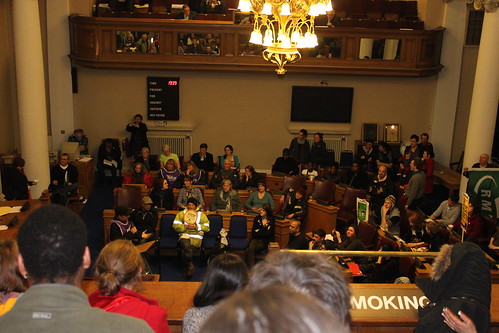
On Wednesday night I was at Lambeth town hall in Brixton, south London, where around 150 protesters occupied the council chamber during a meeting, forcing councillors to leave.
 
Lambeth Town HallThe council meeting was to pass a budget that contained cuts of around £79m over three years. Once the councillors had left (to hold a private meeting at which the budget was passed), the protesters declared a “people’s democracy” in which everyone could voice their concerns.
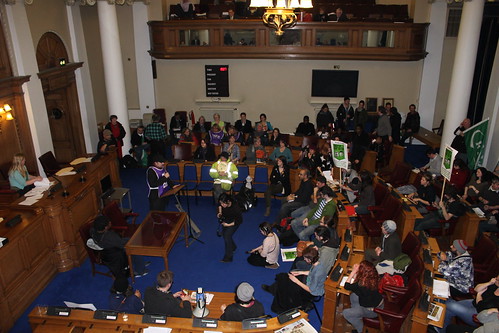
 
One of the many things that struck me during the protesters’ meeting was the unions’ reluctance to let the voluntary sector run services. When the protesters started talking about a council plan to let voluntary and community groups run the borough’s playgrounds, the reactions ranged from scorn to pity.
 
“The voluntary sector just can’t run our playgrounds, no matter how well-intentioned it is,” said one of the town hall occupiers. “It’s just not capable of doing it.”
 
Others took a more hostile approach, muttering loudly about voluntary groups “taking jobs” from the public sector.
 
I hadn’t realised until last night how much of a problem this could be for the sector. Charities are under pressure from both sides of the political spectrum: those on the right think they shouldn’t get state funding in the first place, and those on the left think that when they do they are undermining the public sector.
 
Lambeth Town HallThis could be a particular problem in Lambeth, where the council has a radical plan to become Britain’s first “co-operative council” in which services are provided by voluntary groups wherever possible.
 
But I’m sure it won’t be limited to Lambeth. Reluctance, or in some cases open hostility, from those in the public sector – particularly when their jobs are at risk – must be making life hard for voluntary groups across the country.  

Social impact bonds are hot topics

The social
impact bond seems flavour of the month. The US budget on 14 February was
sprinkled with references to the concept, there known as a “pay for success”
bond, and as much as $100m could be spent on them in the next few years. Other
countries are also interested.

Everyone seems
to like the idea, because economically everyone’s incentivised in the right way
– the government only pays out once you’ve proved you’ve saved them cash,
charities get freedom to work the way they want to, and investors get what they
always want – a chance to turn cash into more cash.

Two key issues
need to be addressed, though.

One is whether
the bond can be priced to attract commercial investors. After all, this will
need a lot of up-front capital. Foundations and philanthropists can’t provide
all of it. And commercial investors will go where they can get the best reward
for the lowest risk, so the bond has to have an attractive profile for them.

With the
original bond, working with offenders in Peterborough, there’s a lot of risk.
If the project goes very well, investors get a return of around 10 per cent a year.

Using some
back-of-the-envelope reckoning, that seems a slightly better return than you’d
get on the stock market over a similar period, and a significantly better one
than the bond market. But you’re very unlikely to lose all your cash investing
in those markets, and you can sell up if you start to get nervous.

The key question
is: how often do social impact projects go wrong? If the risk is very low, 10
per cent a year is good compensation. If high, you won’t find many investors
taking a punt for that return.

Until there’s more
data, it’s not surprising foundations are the ones carrying all the risk,
because they also care about social outcomes, and are used to funding projects
like this with no prospect of a return at all.

We won’t know
the risk associated with these projects until we’ve seen a lot of them, and
once we do, we’ll find out what sort of return commercial investors will
demand.

However the
government can probably afford to pay whatever the market wants, because early
interventions save it huge amounts of cash, and it only needs to pay for those
that work.

The other,
potentially thornier issue which could derail the social impact bond is that of
metrics. How do you measure success?

This has proved
surprisingly tricky to nail down on the pilot project, even though it’s based
on an apparently simple metric: have released offenders committed more crimes.

This seems easy
to check, but there are a lot of potential issues. What if reoffending has gone
down because of something unconnected to your intervention, like a change in
the job market or an increase in benefits? How do you stop the people you’ve
contracted cherry-picking easy wins, and leaving difficult cases worse off than
before?

And are you
reducing reoffending in a way that helps society? After all, if you offered
courses in how to rob houses, you might have less clients back before the beak,
and you’d get paid. But it wouldn’t cut crime.

The pilot seems
to have found a way around these issues. But a reduction in crime is easier to
measure than an improvement in other fields like children’s services or
healthcare.

Some good
economists are spending a lot of time thinking about this problem, so it seems
likely, in time, that answers can be found. But it seems likely that devising
good mechanisms for social impact bonds will keep a lot of bright guys in work
for a long time to come.

The smoke and mirrors are getting annoying

Saying that politicians sometimes manipulate statistics is like saying that footballers sometimes fancy their teammates’ girlfriends. Not only is it an understatement, but it’s also one of those things that everyone assumes to be their modus operandi. And it only makes the headlines when a particularly audacious episode takes place. 
 
But the latest trend in abusing the numbers is bothering me more than usual. Both Francis Maude and Nat Wei have said this week that 75 per cent of charities receive no government funding. In both cases, the figure was used as evidence that the big society can function despite public spending cuts.
 
I’m sure it’s true that three quarters of the 180,000 charities registered with the Charity Commission get no cash from the state. But how many of those are defunct, barely operational or tiny in scale?
 
A more accurate statistic would be that, according to the NCVO’s Civil Society Almanac, around 36 per cent of the sector’s overall income comes from the public purse. And, funnily enough, this figure wouldn’t prevent Maude and Wei from making their point quite effectively.
 
Of course, there are other statistics for charities to be annoyed about. Nick Hurd’s repeated claim that the government is pumping £470m into the voluntary sector, when in fact this is just a reduced version of the usual Office for Civil Society budget, grates somewhat.
 
So does David Cameron’s insistence that the £100m Transition Fund proves the government is supporting the sector – with the notable absence of any recognition that charities and voluntary groups will pay around £150m more in VAT this year than last year, and receive around £100m less in Gift Aid because of the end of transitional relief.
 
But somehow, the 75 per cent figure is the most annoying part of the smoke and mirrors – a phrase Nick Hurd used to use a lot when castigating the Labour government. It’s a blatant insult to the intelligence of the sector and the public.

Big society fatigue sets in

It’s been hard to get away from the big society in the last couple of weeks. All the papers – including the Sun – have been on about it, and every second programme on radio and TV has been trying to get a handle on it.

It’s been enough to make even current affairs addicts run screaming from the room. Nick Hurd, the Minister for Civil Society, drily thanked a Third Sector conference today “for this rare opportunity to talk about the big society.”

So it’s clear that big society fatigue is beginning to set in. What’s less clear is whether the big society itself is beginning to sink in – to make a meaningful impact on the public and the sector.

Those who conceive of it as a set of programmes, at least in part, have been rewarded to some extent. Under intense pressure to ‘do something’, the government has rushed out somewhat sketchy details of the Big Society Bank and a proposed Big Society ISA.

The first recipients of the Transition Fund have also been announced, and news is said to be imminent about the community organisers programme. The big society advisor Lord Wei says the big society is about to move from the ideas phase to the social action phase.

But to what extent is the big society really a set of government programmes? And if such programmes are part of it, are they anything more than a stepping stone to the big society proper?

I say that because it seems to be the essence of the big society that you don’t actually have government programmes any more. You’ve got to do it yourself, chaps. It’s a whole new mindset – a different way of looking at the world.

You could call it the sink or swim society. But that might be a bit harsh, because there’s an upside as well – an opportunity for more of the voluntary sector to become truly voluntary: independent, confident, and able to challenge the government with impunity.

Just how useful is the Big Society Bank going to be?

The announcement that the Big Society Bank
was to receive £200m funding
“on a commercial basis”, rather than £1bn as a
gift, surprised a lot of people, including, it appeared from some conversations
I had yesterday, some people in the banks and the Treasury themselves.

It leaves the third sector in a different,
less useful place than expected. There is less money, on worse terms, with much
more uncertainty attached to it, than anticipated. This may sound familiar to
some readers.

The trouble we have now is that we have
little idea how useful this money is. “On a commercial basis” covers a
multitude of sins. If that £200m is to be lent once and returned six months
later, all at 50 per cent interest, it will not receive a lot of takers.

The banks, at the moment, don’t seem to be
thinking that way. Their representatives don’t seem to be anticipating much
return from their cash, and are viewing it as a semi-philanthropic endeavour.

Nonetheless, there’s still much to play
for. The banks don’t know, or at least aren’t saying, how long the money will
remain under the control of the Big Society Bank. They’ve made no promise about
the terms on which they’ll lend it. They haven’t even promised that they will
lend it. The money is contingent on the “objectives, business plan and
structure” of the Big Society Bank.

Still, while it’s worth remembering that
deals with the bank have a habit of getting worse the more you look at them,
it’s also worth remembering that some money is better than no money, and no
money is what the Big Society Bank has today. Perhaps it’s ill-mannered to cavil too much over the terms on which the high street banks’ cash is
provided.

If they commit £200m, if they leave it in
the Big Society Bank for several years, and if it can be lent out at reasonable
rates, then the fact they themselves make a bit of profit is far from the end
of the world.

That, of course, is still a lot of ifs.

The tune has changed for the big society

Back in October, when I went to the
Conservative Party Conference in Birmingham, the big society was everywhere. It
would have been physically impossible for one person to go to every conference session that
had the phrase in its title.

It was the buzz phrase of the conference, and
was being used in a universally positive way by charities, think tanks, MPs and
councillors. Everyone was asking: What is the big society? How can we
contribute to this exciting new idea? What will we gain from it?

Just four months later, the picture has
changed. As councils and charities across the country see their funding cut and
their services closing, the big society has lost its fuzzy glow and become
intrinsically linked to a sense of fear and vulnerability and a struggle to survive.

During the coalition’s first six months in
government, many in the voluntary sector were prepared to get caught up in a
big, abstract, enticing new idea, particularly if they thought this would
endear them to the new administration and protect them from the worst of its
impending cuts.

A few months on, they have gone back to
thinking with their heads rather than their hearts. As more charities realise
that no amount of fawning over the big society idea will protect them from the
cuts, more will follow CSV’s Dame Elisabeth Hoodless in speaking out against
it.

This may well have the effect of forcing
government ministers to quietly stop using the phrase. But unless it also
forces them into U-turns on major policy areas, will anything have been
achieved?